
Saturday, July 18, 2020

Solar Orbiter: Closest ever pictures taken of the Sun

Solar Orbiter: Closest ever pictures taken of the Sun


Image copyrightSOLAR ORBITER/EUI TEAM (ESA & NASA)A "camp fire"
Image captionThe arrow points to a "camp fire". The circle at bottom-left gives an indication of size
Presentational grey line
New pictures of the Sun taken just 77 million km (48 million miles) from its surface are the closest ever acquired by cameras.
They come from the European Space Agency's Solar Orbiter (SolO) probe , which was launched earlier this year.
Among the UK-assembled craft's novel insights are views of mini-flares dubbed "camp fires".
These are millionths of the size of the Sun's giant flares that are routinely observed by Earth telescopes.
Whether these miniature versions are driven by the same mechanisms, though, is unclear. But these small flares could be involved in the mysterious heating process that makes the star's outer atmosphere, or corona, far hotter than its surface.
"The Sun has a relatively cool surface of about 5,500 degrees and is surrounded by a super-hot atmosphere of more than a million degrees," explained Esa project scientist Daniel Müller.
"There's a theory put forward by the great US physicist Eugene Parker, who conjectured that if you should have a vast number of tiny flares this might account for an omnipresent heating mechanism that could make the corona hot."
Whatever their role, the camp fires are certainly small - which may explain why they've been missed up to this point, says David Berghmans, from the Royal Observatory of Belgium and the principal investigator on the probe's Extreme Ultraviolet Imager (EUI).
"The smallest ones are a couple of our pixels. A pixel corresponds to 400km - that's the spatial resolution. So they're about the size of some European countries," he told reporters. "There may be smaller ones."
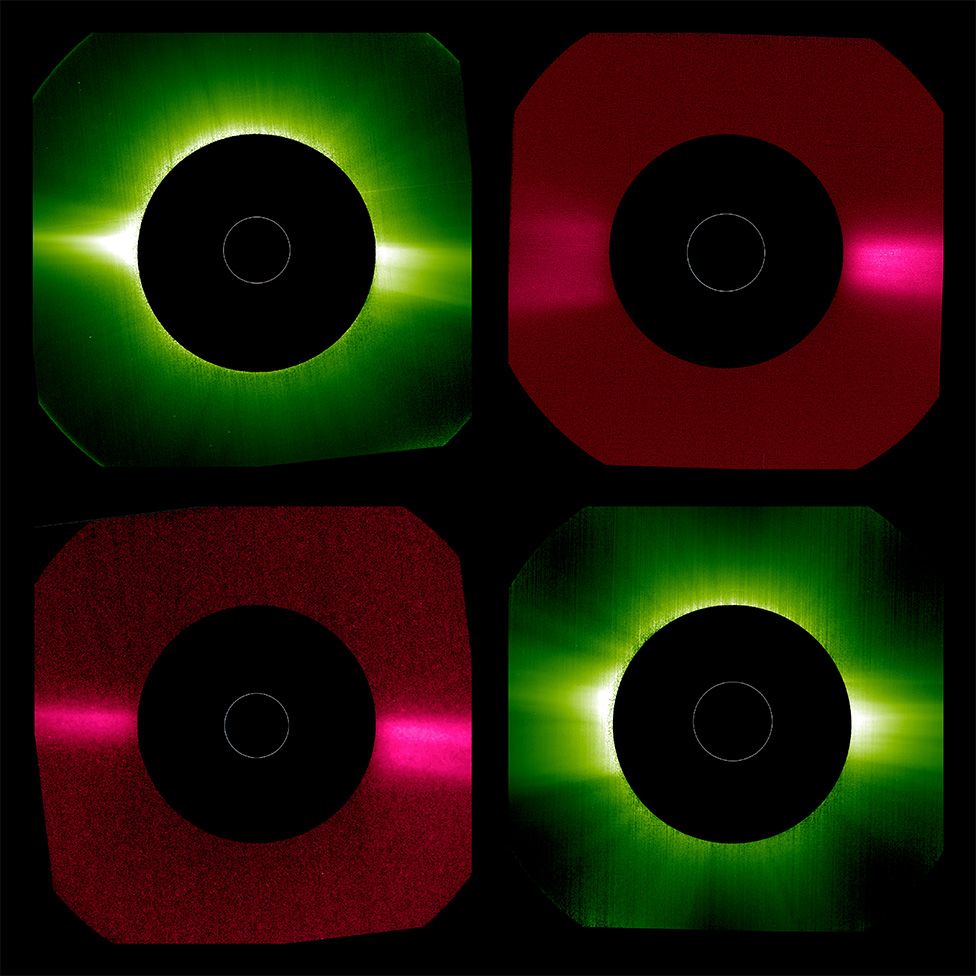
Image copyrightSOLAR ORBITER/METIS TEAM (ESA & NASA)Metis
Image captionThe Metis instrument is a coronagraph. It blocks out the dazzling light from the solar surface, allowing the fainter outer atmosphere of the Sun to be seen. Different frequencies show different features
Presentational white space
The European Space Agency (Esa) satellite was despatched on a rocket from Cape Canaveral in the US in February. Its mission is to reveal the secrets of our star's dynamic behaviour.
The Sun's emissions have profound impacts at Earth that go far beyond just providing light and warmth.
Often, they are disruptive; outbursts of charged particles with their entrained magnetic fields will trip electronics on satellites and degrade radio communications.
SolO could help scientists better predict this interference.
"The recent situation with coronavirus has proved how important it is to stay connected, and satellites are part of that connectivity," said Caroline Harper, the head of space science at the UK Space Agency. "So, it really is important that we learn more about the Sun so that we can predict its weather, its space weather, in the same ways we've learned how to do (with weather) here on Earth."
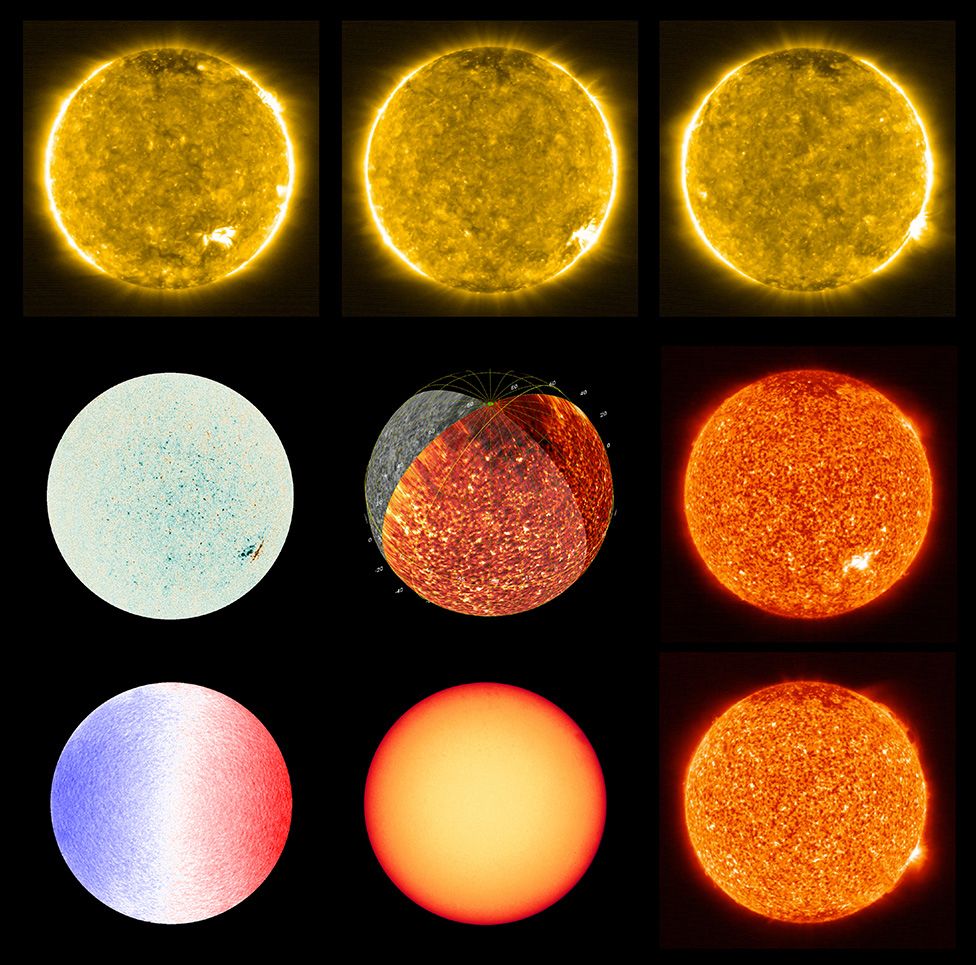
Image copyrightSOLAR ORBITER/EUI TEAM; PHI TEAM/ESA & NASADifferent views
Image captionSolar Orbiter's suite of instruments will allow it to untangle the details of what drives the Sun's dynamic behaviour. Sensors can pick out the different layers of the star's atmosphere and track its twisting magnetic fields
Presentational white space
Solar Orbiter has been set on a series of loops around the Sun that will gradually take it closer still - ultimately to a separation of less than 43 million km.
That will put SolO inside the orbit of the planet Mercury.
The pictures showcased on Thursday come from the most recent near pass, known as perihelion . This occurred in mid-June, inside the orbit of Venus.
For comparison, Earth sits about 149 million km (93 million miles) on average from the Sun.
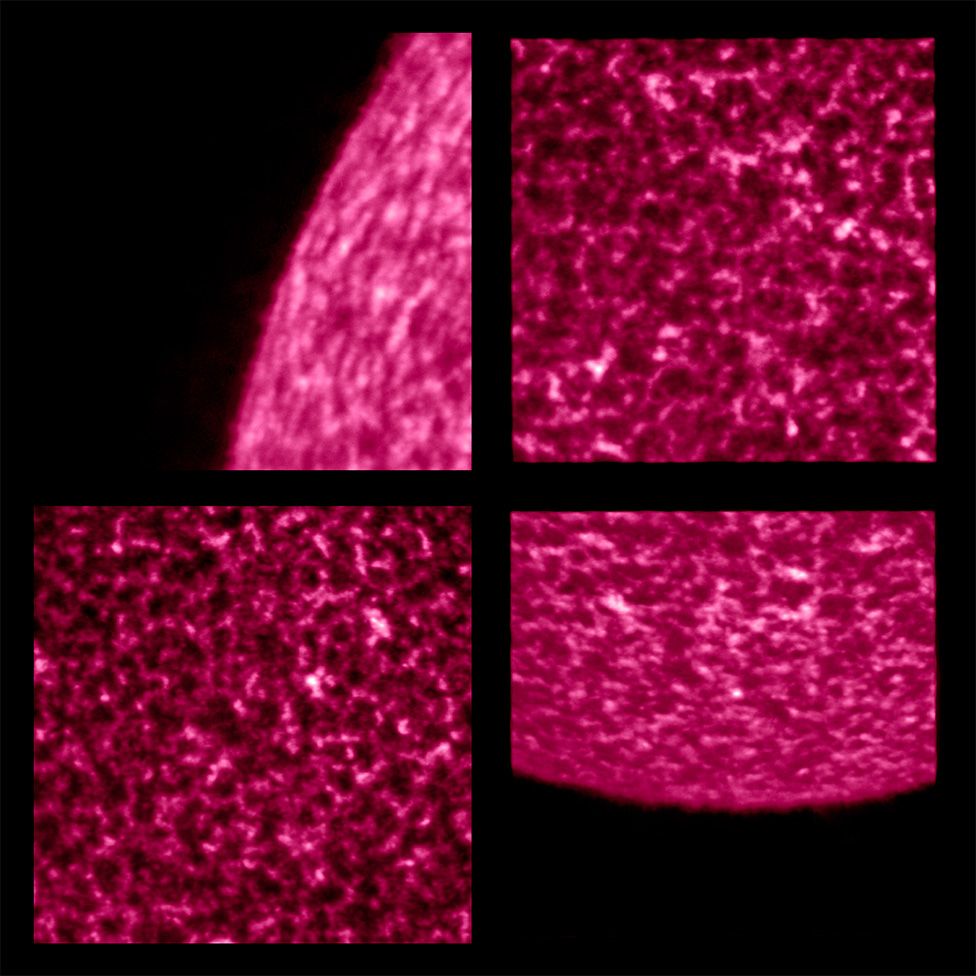
Image copyrightSOLAR ORBITER/EUI TEAM (ESA & NASA)Chromosphere
Image captionAt a particular wavelength of light known as Lyman-alpha, the EUI will pick out the hydrogen in the Sun's lower atmosphere (chromosphere). Temperatures in this region are 10,000 to 100,000 degrees
Presentational white space
To be clear: while the new images have been taken from the closest ever vantage point, they are not the highest resolution ever acquired. The largest solar telescopes on Earth will always beat SolO on that measure.
But the probe's holistic approach, using the combination of six remote sensing instruments and four in-situ instruments, puts it on a different level.
Esa's senior advisor for science & exploration, Mark McCaughrean, told BBC News: "Solar Orbiter isn't going closer to the Sun just to get higher-resolution images: it's going closer to get into a different, less turbulent part of the solar wind, studying the particles and magnetic field in situ at that closer distance, while simultaneously taking remote data on the surface of the Sun and immediately around it for context. No other mission or telescope can do that."
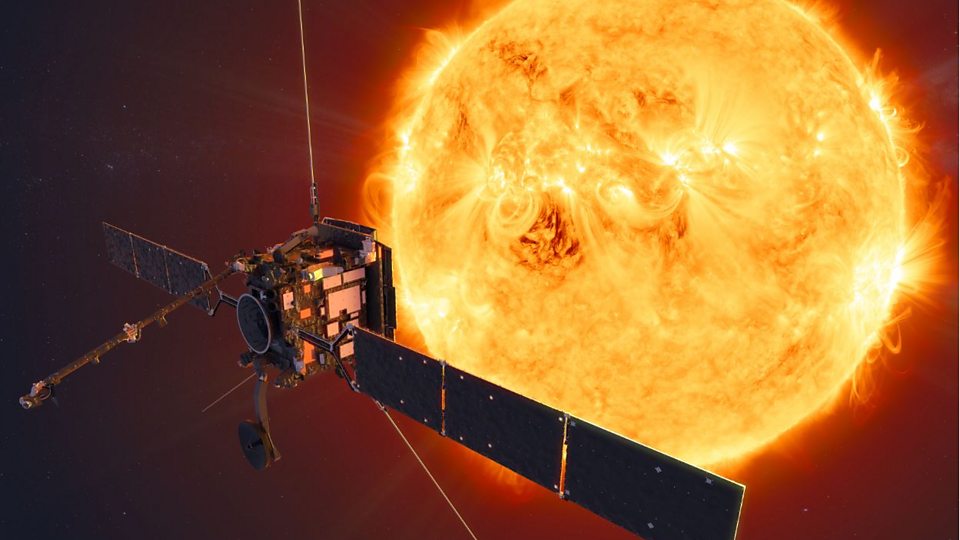
What is Solar Orbiter and what's it going to do?
Video captionWhat is Solar Orbiter and what's it going to do?
It will be a couple of years yet before Solar Orbiter makes the first of its very close encounters with the Sun (at a distance of 48 million km).
As the mission progresses, SolO will, with the gravitational assistance of Venus, also lift itself out of the plane of the planets so that it can more easily see the Sun's poles. "Terra incognita", as Sami Solanki, from the Max Planck Institute for Solar System Research and PI on Solo's Polarimetric and Helioseismic Imager, likes to call these regions.
It's at the poles where we may finally learn the fundamentals of the Sun's magnetism.
"We know that the magnetic field is responsible for all the activity that the Sun produces, but we don't know how the magnetic field itself is produced," Solanki said.
"We think it's a dynamo that is doing that inside the Sun, similar to the dynamo inside the Earth. But we really don't know how it functions. But we do know that the poles play a key role."
Holly Gilbert, the Solar Orbiter project scientist at the US space agency, Esa's major partner on the mission, enthused about the science ahead.
"If we've already made some discoveries with just the 'first light' images, just imagine what we're going to find when we get closer to the Sun, and when we get out of the ecliptic. Very exciting."
Jonathan.Amos-INTERNET@bbc.co.uk and follow me on Twitter: @BBCAmos


Friday, April 10, 2020

SHIDAN TOLOUI-WALLACE

https://www.shidantolouiwallace.com/about


Her Story

Shidan Toloui-Wallace is an admired contemporary Baha’i chanter.
Her reputation was established in the 90’s during her service in Haifa at the Bahá’í World Centre, as she was regularly selected to chant on special occasions. The greatest honour among all other occasions for Shidan, was the invitation to chant at observances of Holy Days in the sacred grounds of the Shrine of Bahá'u'lláh.
It was in Haifa that, with the permission of the Universal House of Justice, Shidan recorded her first album with her dear friend and fellow Bahá’í World Centre staff member Taraneh Rafati, titled the Call of Carmel. Accompanying them was Shidan’s uncle, the late Massod Missaghian, on the santoor (a hammered dulcimer).


Shidan’s daughter Shadi, is also a talented songstress who has produced albums, Leather Bound Book (2009), Verdant Isle (2011) and Daughter of the Kingdom (2016). In all three of these albums Shidan was invited to collaborate with Shadi. This was the beginning of a very unique fusion of the Western and Eastern music, set to the Baha’i writings.
In 2012 Shidan recorded her second album, Phoenix of Love, produced by American Bahá’í guitarist, producer and a dear friend, Louie Shelton. Shidan invited her daughter to collaborate with her on three tracks on this Album. In August 2019 Shidan released her third Baha’i inspired album, Radiant Heart. A mix of old and new collaborations with her daughter Shadi, the album features their unique ability to blend the East and West through soul stirring melodies in English, Farsi and Arabic, set to the Baha’i writings. In early 2019 they launched a Kickstarter campaign to raise the funds to produce their first fully collaborative album, Radiant Heart.
Her music contains predominantly a style that reflects Shidan’s heritage and experience in Persian song and tones, it also has a taste of the wonderful fusion of East and West so loved by those who appreciated music from all parts of the world. Shadi’s soulful contribution is joined with Shidan’s melodious tones in three tracks to bring you a taste of this melding of two cultures. Shidan Toloui was born in Tehran, Iran, was raised there until she was 16 when her family relocated to Canada. After marrying an Australian Bahá’í, Paul Wallace, and adding his surname to hers, she moved to Australia in the 1980s. Since then, Shidan Toloui-Wallace has chanted at national and international conferences and gatherings in countries including Australia, Canada, Israel and the United States. Her latest honour was to chant at the opening ceremony of the Chilean temple in 2016.
Shidan was raised in a family of musicians. She learned her art form from her father and mother, who chanted prayers every morning. They imbued the love and respect for this sacred music into their daughter.
“As a Bahá'í I was brought up to believe that music is the food for the soul so to me life without music would be like starving my soul, to me chanting is like an expression of my soul the same way artists express their feelings in a painting.”


Thursday, November 14, 2019

Central figures of the Baha’i Faith

Dr Moojan Momen explores life of the founder of the Baha’i Faith, as well as the lives of his forerunner and successor. He delves into the key events concerning their beliefs and teachings and reflects on their legacy.
The Baha’i Faith has three central figures. The most important of these is Baha’u’llah who is regarded by Baha’is as the founder of the religion. His writings are regarded as the latest revelation of the Word of God and thus are the ones that are most relevant for humanity today. He was preceded by the Bab, whom Baha’is regard as having paved the way for Baha’u’llah. According to Baha’i theology both the Bab and Baha’u’llah are termed ‘Manifestations of God’, the intermediaries between God and humanity, who reveal God’s Will for the age in which they come. These two figures are considered to be of equal station to the central figures of other religions such as Muhammad, Jesus Christ, Moses, Zoroaster, Krishna and the Buddha. The third of these central figures of the Baha’i Faith is ‘Abdu’l-Baha, who was appointed by Baha’u’llah to succeed him as leader of the Baha’i community and as the sole authorised interpreter of Baha’u’llah’s writings.

The Bab

The Bab began life as Sayyid ‘Ali Muhammad Shirazi (1819–1850), a merchant from Shiraz. The title ‘Sayyid’ at the beginning of his name denotes that he was a descendent of the Prophet Muhammad, and in his early life he followed Twelver Shi‘ism, the branch of Islam that is prevalent in Iran. In 1844 he experienced a series of revelatory visions after which he pronounced himself to be the bab (the gate) to the Mahdi, the Hidden Imam of Twelver Shi‘ism. The first book that the Bab wrote after he put forward his claim is the Qayyūm al-asmā.

The Qayyum al-asma' (‘Maintainer of the names’), the first major work of the Bab

The Qayyūm al-asmāʼ (‘Maintainer of the names’)
The Qayyūm al-asmā: This is the first book that the Bab wrote after he put forward his claim. Although his formal claim in this book is to be the representative of the expected Imam Mahdi, those who were able to read the book discerned that he was in fact making a far higher claim – that this book was Divine Revelation and therefore that he was a Messenger of God. 19th century.
View images from this item  (2)
Usage terms
The Bab dispersed his leading disciples from Shiraz to various parts of Iran, India and what is now Iraq, to spread news of his movement, and thus gained many followers. This rapid spread was met with hostility from the religious leaders of Islam. Within eight months, senior Shi‘i and Sunni clerics were calling for the death of the founder of the movement and anyone who was spreading it. On his return from a pilgrimage to Mecca the Bab was arrested and confined to house arrest until 1846, when he left for Isfahan. There he was befriended by a powerful governor who eventually became a follower of his. This governor died in February 1847 and the Prime Minister ordered the Bab’s confinement in a fortress in the remote north-west corner of the country. As the Prime Minister found that the Bab was still able to communicate with his followers, he was transferred to another fortress after nine months.

Imprisonment and persecution

In July 1848 the Bab was brought to Tabriz and put on trial before the Crown Prince and the senior clerics of the city. At this trial, the Bab openly declared himself to be the Imam Mahdi, the one that Muslims were awaiting. After the trial, he was tortured and returned to his place of imprisonment. In September 1848, this Crown Prince became Naser al-Din Shah (r. 1848–1896) on the death of his father, the previous shah. Up until this point, the opposition to the movement was confined to religious debate and denunciations from the pulpit. However, with the accession to the throne of a new shah, and the installation of a new prime minister, the persecution intensified. It was during this period of incarceration that many of the Bab’s most important books were written, in particular the Persian Bayān, in which are the laws and major teachings of the new religion. Also in this book are frequent references to ‘Him Whom God shall make manifest’, a messianic figure foretold by the Bab.

The Persian Bayan (‘Explanation’)

Persian Bayan
The Bayān. This book contains the laws and major teachings of the new religion. In this book are frequent references to ‘Him Whom God shall make manifest’, the messianic figure foretold by the Bab.
View images from this item  (2)
Usage terms
Between 1848 and 1850 there were three major episodes of armed conflict between military forces and the Babis. In July 1850, the Bab was brought from his confinement and publicly executed in Tabriz. Two years later in August 1852, a small group of Babis who had been meeting in Tehran tried to assassinate the shah. The attempt was poorly planned and failed, but it unleashed a further wave of persecutions throughout Iran. After this, the Babi movement was suppressed and went underground.

Baha’u’llah

Baha’u’llah (‘the Glory of God’) was the title taken by Mirza Husayn ‘Ali Nuri (1817–1892), who is regarded as the founder and central figure of the Baha’i Faith. He was born in Tehran and was a member of a family of important government and court officials. His father was a minister to one of the royal provincial prince governors.

Album of Baha’i calligraphy

Album of Baha’i calligraphy
Calligraphic exercises done by Baha’u’llah as a child. 19th century.
View images from this item  (7)
Usage terms
Baha’u’llah, however, rejected the life of a courtier and instead joined the Babi movement shortly after its commencement. He played a leading role in the movement, converting a large number of people in his home district of Nur in Mazandaran, as well as in Tehran. His home in Tehran was a centre of activity and he himself helped to finance the movement. With the attempt on the life of the shah in 1852 and the persecutions of the Babis that followed, Baha’u’llah was thrown into the Siyah Chal (Black Pit), the shah’s underground dungeon in Tehran. Most of the Babis who were captured at this time were handed over to sections of the government and population and put to death on the streets of Tehran. It was while in this dungeon that Baha’u’llah had the spiritual experience that is regarded as the birth of his prophetic mission. Because no evidence could be found of his involvement in the assassination attempt, he was released but sent into exile. He chose Baghdad, which was at that time part of the Ottoman Empire, as his place of exile. After a year he left that city and spent two years living as a religious ascetic in the mountains of Kurdistan. He then returned to Baghdad, where he set about reviving the Babi community. It was during this period of residence in Baghdad that Baha’u’llah wrote a number of important works on mysticism and ethics (such as the Seven Valleys and the Hidden Words) as well as his major book of proofs, the Kitāb-i Īqān (the Book of Certitude).

Kitab-i Iqan (‘Book of Certitude’), a major Baha’i work by Baha’u’llah

First folio from Kitab-i Iqan (‘Book of Certitude’). Page has 13 lines of script, four of which are underlined in red.
The Kitāb-i Īqān (The Book of Certitude) is Baha’u’llah’s book of proofs. In this book, Baha’u’llah explains how the prophecies regarding the Day of Judgement and the Day of Resurrection have been fulfilled spiritually, not literally. 19th century.
View images from this item  (2)
Usage terms

Exile and the founding of the Baha'i Faith

Although Baha’u’llah advocated peace and reconciliation, the Iranian government still perceived a threat. At the insistence of the government, he was summoned to Istanbul. Just as he was leaving Baghdad, he made a private declaration to a small group of Babis that he was the figure of ‘Him whom God shall make manifest’ that the Bab had promised. After three months in Istanbul, during which he refused to pander to the officials of the Ottoman court, he was further exiled to Edirne. In 1866 he openly announced his claim to be not only the one promised by the Bab, but also the promised one of all religions. He wrote to a number of major world rulers and leaders to declare his mission and called for the establishment of world peace.

Baha’u’llah’s letter to Queen Victoria

Baha’u’llah’s letter to Queen Victoria
Baha’u’llah’s letter to Queen Victoria, in which he commends her for having acted against the slave trade and also for the system of parliamentary democracy in Britain. He urges elected representatives in every land to look only to what benefits the whole of humanity when they consult together. He calls on the monarchs and rulers of the world to turn to peace and reduce the armaments that they have amassed, thus relieving the burden of taxes they have laid on their peoples.
View images from this item  (1)
Usage terms
While in Edirne, his younger half-brother, Mirza Yahya, who had the title Azal, challenged Baha’u’llah with the claim that he had been appointed leader of the Babis. However, Baha’u’llah was not claiming leadership of the Babis, but the founding of a new religion. By the 1870s an estimated 95% of Babis had become Baha’is and soon there were many conversions from other groups such the Shi‘is, Jews and Zoroastrians of Iran.

When did he write his most important social teachings?

In 1868, Baha’u’llah was exiled by the Ottoman government to the walled city of Akka (then part of Ottoman Syria, now Acre in Israel), where he was at first imprisoned in the citadel of the city and then, after two years, kept in the city under house arrest. During this time he handed over much of the task of organising the movement to his son, ‘Abdu’l-Baha, and focussed on his writing and meeting Baha’i pilgrims. At this time, he produced what would be his most important work: the Kitāb-i Aqdas (the Most Holy Book).

Kitab al-aqdas and other Tablets by Baha’u’llah

o _15729, folio 1 verso. Manuscript copy of Baha’u’llah’s most important book, the Kitāb-i Aqdas (The Most Holy Book)
19th-century manuscript of the Kitāb al-aqdas: Baha’u’llah’s most important work containing the laws and some of the most important new social teachings of the Baha’i Faith. 
View images from this item  (2)
Usage terms
In 1877, Baha’u’llah moved outside the walls of Akka and after two years he took up residence in a mansion called Bahji, near Akka. During this time, he produced a series of major writings in which he expanded on his social teachings and centred on the need for a new social structure that would be conducive to peace and harmony in society and in the world as a whole. He directed the expansion of his religion by instructing his followers to spread the religion in areas such as Egypt, the Caucasus, Central Asia and India.
Baha’u’llah died in Bahji in 1892. His shrine at Bahji is considered the holiest place in the world by Baha’is. It has become a shrine for pilgrims and is the direction of prayer for Baha’is. The remains of the Bab were rescued and after being secretly kept in Iran for fifty years, they were transferred to Akka. Eventually in 1909, they were interred in a shrine on the slopes of Mount Carmel in the city of Haifa across the bay from Akka.

‘Abdu’l-Baha

‘Abdu’l-Baha (‘the servant of the Glory’, 1844–1921) was the title taken by ‘Abbas Effendi, the eldest son of Baha’u’llah. He was born in Tehran and was eight years old when he went into exile with his father and family to Baghdad, and then to Istanbul, Edirne and Akka. From an early age, he showed a remarkable degree of wisdom and intelligence. Although after they left Tehran he ceased to attend school, at the age of eighteen he composed a treatise in commentary on an Islamic Tradition for an Ottoman official, in which he showed himself to have mastery of Islamic mysticism and philosophy. When he was twenty-seven years of age, an English missionary doctor, Dr Thomas Chaplin, wrote in The Times newspaper (of 5 October 1871, p. 5) that ‘Abdu’l-Baha ‘showed a minute and accurate knowledge of the Old and New Testaments.’ In Akka, ‘Abdu’l-Baha took care of the relations of the exiles with the local government and population, leaving Baha’u’llah free to concentrate on meeting with pilgrims and composition of books and letters.

How did ‘Abdu’l-Baha add to the faith?

Baha’u’llah made ‘Abdu’l-Baha his successor and the sole authorised interpreter of his writings. Baha’is also regard him as the perfect exemplar of the Baha’i ethical teachings. During ‘Abdu’l-Baha’s leadership, the Baha’i Faith spread to North America, Europe, Australia, China, Japan and many other countries. ‘Abdu’l-Baha himself played a major role in this expansion by travelling to North America and Europe in 1911–1913, during which he attracted large numbers to his addresses in halls, universities, churches, mosques and synagogues and was given, particularly in North America, a great deal of attention by newspapers.

‘Abdu’l-Baha’s treatise on the establishment of a just, progressive and divinely-based government

or 8686, folio 1 verso. ‘Abdu’l-Baha’s book The Secret of Divine Civilization (Asrār al-Ghaybīyya fī Asbāb al-Madanīyah).
‘Abdu’l-Baha’s book The Secret of Divine Civilization (Asrār al-Ghaybīyyah fī Asbāb al-Madanīyah). This is a work written by ‘Abdu’l-Baha in 1875 in response to the reforms initiated in Iran by Mirza Husayn Khan Mushir al-Dawleh Sipahsalar. However, the general principles that it propounds are considered by Baha’is to have universal relevance. It was distributed anonymously (so as to avoid the prejudice that would face a Baha’i work in Iran) and contributed to the debate about reform. It was the second Baha’i book to be printed. This manuscript is dated 1911.
View images from this item  (2)
Usage terms
  • Moojan Momen
  • Dr. Moojan Momen was born in Iran, but was raised and educated in England, attending the University of Cambridge. He has a special interest in the study of Shi`i Islam, the Baha'i Faith, and more recently the study of the phenomenon of religion. His principal publications in these fields include: Introduction to Shi`i IslamThe Phenomenon of Religion (republished as Understanding Religion); Understanding the Baha’i Faith; and The Baha'i Communities of Iran (1851–1921). He has contributed articles to encyclopaedias such as Encyclopedia Iranica and Encyclopedia of the Modern Islamic World as well as papers to many academic journals.
The text in this article is available under the Creative Commons License.


Friday, August 30, 2019

Two shining lights in an Iranian prison’s darkness


Correction: An earlier version of this op-ed incorrectly reported the amount of time Fariba Kamalabadi and Mahvash Sabet have served in prison in Iran. They are now in their tenth year behind bars.

Iranian female prisoners in their cell in Evin prison in Tehran, Iran. (Vahid Salemi/Associated Press)
By Roxana Saberi
June 21, 2017
Roxana Saberi is an Iranian American journalist and author who was imprisoned in Iran for 100 days in 2009.
The most valuable gift I ever received took four years to pass through several hands and cross half the world to get to me. It’s a bracelet made from the threads of a towel I left behind in Tehran’s Evin prison.
Whenever I wear the pink-and-rose-colored band, I think of Fariba Kamalabadi, the woman who wove it, and her friend Mahvash Sabet — two of my former cellmates, who are now serving their tenth year behind bars.
I haven’t seen the two women since shortly before I was released in 2009, but they continue to inspire me and many others who know them or have heard their story.
Fariba and Mahvash, along with five male colleagues, had tended to the spiritual and social needs of Iran’s minority Bahais, who are viewed as heretics by the Islamic regime. For this, the seven were accused of “spreading propaganda against the regime” and “engaging in espionage” — charges they deny. They were each given 20-year sentences, which reportedly have been reduced to 10 years.
Despite the serious nature of their situation, Mahvash and Fariba exuded a peace that I felt the moment I was transferred to their cell. They welcomed me gently and cleared a space for the blankets that served as my bed. I sat down and asked how long they’d been there.
“One year,” Mahvash said.
“Ten months,” Fariba said.
And yet they were still smiling.
I asked them how they could remain so calm. “We trust in God to do what is best for our community,” Mahvash replied. “If he thinks we can serve our faith better by remaining here, we accept it.”
One of Fariba’s relatives recently described this perspective to me: “Fariba believes if you want to make a positive change in the world, you need to pay a price.”
“Though they were in prison, their spirits seemed unshackled,” recalled another former prisoner, who spoke on condition of anonymity. “They taught me to see my imprisonment as part of my destiny. I stopped asking, ‘Why me?’ and could tolerate even solitary confinement.”
Mahvash and Fariba helped me, too, to accept the reality of my situation — to let go of regret for not fleeing my Tehran apartment before four intelligence agents forced their way in to arrest me, and to stop yearning for an earthquake to split open the prison walls. Bad things happen to all of us, my cellmates reminded me. What matters is how we deal with them.
The two women dealt with their circumstances by making the most of every day. They exercised in their cells, discussed the books they were allowed to read and asked me to teach them English phrases. (For fun, I also taught them a few choice curse words.)
Mahvash and Fariba also taught me compassion, even for our interrogators, who subjected us to relentless questioning, pressured us to confess to false charges and threatened us with long sentences and even execution.
When I asked if they ever became angry, Mahvash replied, “We believe in love and compassion for humanity, even for those who wrong us.”
Mitra Aliabouzar, who was a student activist when she met Mahvash and Fariba in Evin prison in 2012, described them as “selfless.” By that time, they had been transferred to the prison’s general ward with more than 20 other female political prisoners of disparate ideologies and faiths.
The inmates became friends and worked together to keep the ward clean. “One time I accidentally overslept,” Mitra remembered. “It was my turn to clean the bathroom, but Fariba cleaned it for me” — though she had a bad back.
Fariba, a psychologist, also gave advice to inmates who came to her with personal problems. “She obviously had a lot of issues on her plate,” Mitra said, “but she wouldn’t talk about her troubles. Instead, she listened.”
Mahvash, who had been an elementary school principal before Iran’s 1979 Islamic Revolution, began sharing her poetry with other prisoners. A number of her poems were published outside Iran, in English, in 2013. In “Place of Peril,” she suggests she will never be silenced:
If they cut open our veins, red tulips will blush like blood in the fields
If they padlock our lips, the mouths of a thousand spring buds are unsealed.
The seven Bahai leaders are expected to be released next year. Like many other prisoners, Mahvash, now 64, and Fariba, 54, long to return to their families, feel the sunshine on their skin and smell the fragrance of trees.
Every time I wear my bracelet made from my prison towel, I am reminded of the light of their kindness, compassion and courage. By all accounts, it has only intensified over the past nine years.